If a back tooth of yours has a large old filling or a piece that has broken away, being handed three different treatment names in one visit is genuinely confusing. At Evercare, we can look at that tooth with you and show you which parts of it are still strong and which parts need covering. This article explains what an inlay, an onlay and a crown each cover, what your dentist weighs up when choosing between them, and what to note down before your appointment.
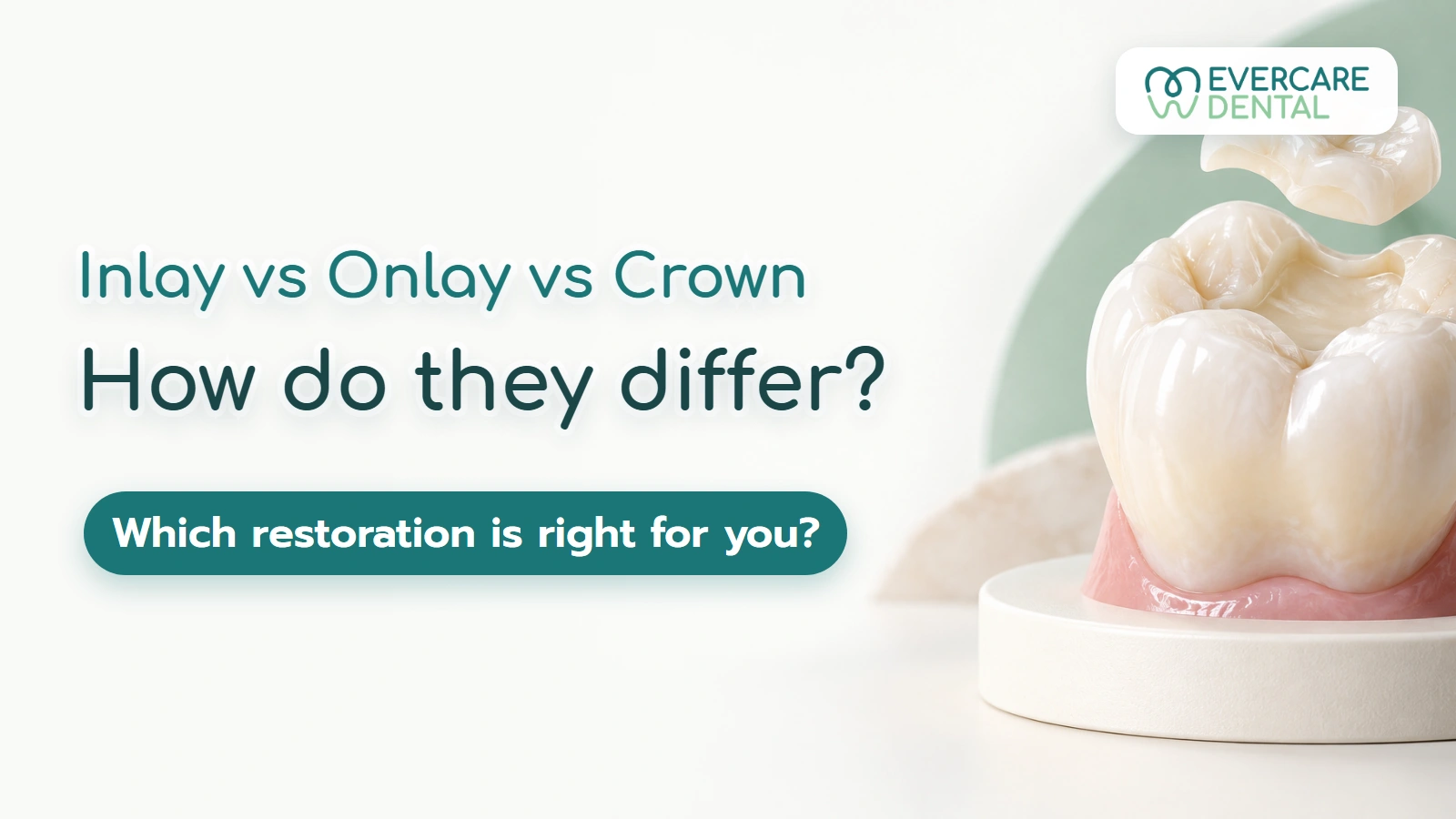
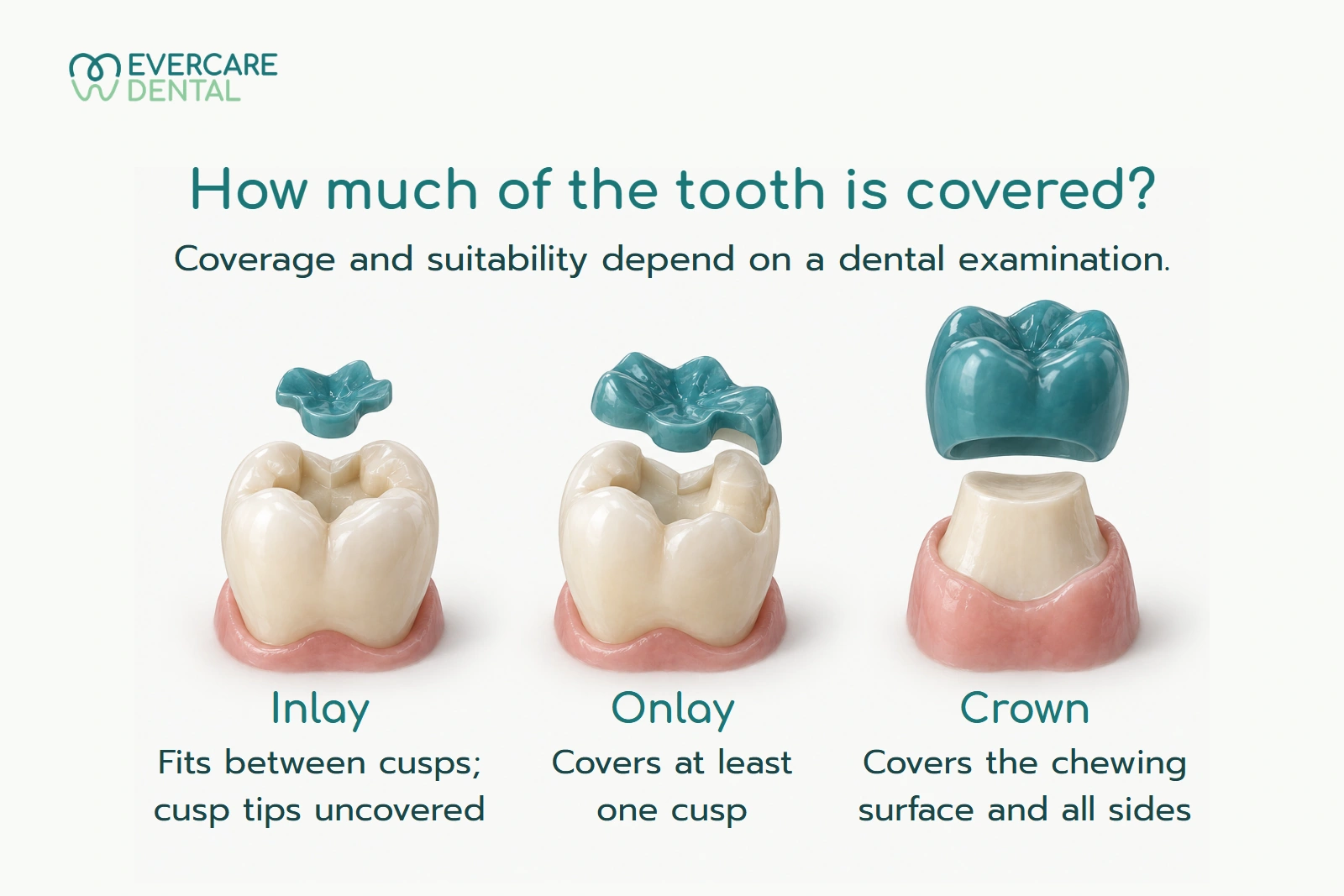
Inlays, onlays and crowns differ in how much of the tooth they cover. An inlay sits in the area between the cusps, an onlay covers at least one cusp, and a crown covers the tooth all the way around. The right choice comes down to how much sound tooth is left and which parts need protecting, so there is no single option that is best for every tooth.
A useful question to start from is this: which parts of this tooth are still strong, and which parts need extra covering? Ask your dentist to answer it from what they actually find when they examine you.
What an inlay, an onlay and a crown cover
All three are custom-made restorations. The piece is made to fit your tooth, then fixed in place after the tooth has been prepared. A cusp is one of the raised points on the chewing surface of a back tooth. The crown of a tooth means the part above the gum, so covering the crown of a tooth does not mean covering the root.
| Restoration | What it usually covers | What to ask your dentist |
|---|---|---|
| Inlay | Fills the area between the cusps without covering the cusp tips | Is the tooth I have left suited to restoring just that area, and why this rather than a direct filling? |
| Onlay | Fills the damaged area and covers at least one cusp | Which cusps are weak and need protecting, and can the rest of the tooth be kept as it is? |
| Crown | Covers the chewing surface and all sides of the tooth once it has been prepared | How damaged or weak is this tooth, and does it suit being covered all the way around? |
The table gives you the general meanings so you can picture the difference. It is not a drilling plan that fits everyone: what a piece is called and how far it extends vary with the actual design. Ask your dentist to point to the area they plan to restore while they explain it.
How your dentist chooses between them
An inlay or an onlay can be an option when a direct filling is not suitable but there is still sound tooth worth keeping. A tooth that is badly broken, or weakened by decay or a large old filling, may suit a crown instead. The size of the decay on its own does not decide the treatment.
Before any piece is made, your dentist checks the tooth you have left, the health of your gums and the tissue inside the tooth. They may take an X-ray or test how the tooth responds where that is indicated, and they treat any active disease first. Grinding and clenching go into the plan too, so mention either habit at the visit.
If there is a crack, its type, position and depth all matter. A crack that reaches the tissue inside the tooth may need root canal treatment as well, and in some cases the tooth cannot be saved. A crown does not make a crack heal, and it cannot guarantee that the crack will stop spreading.
What to note before your appointment
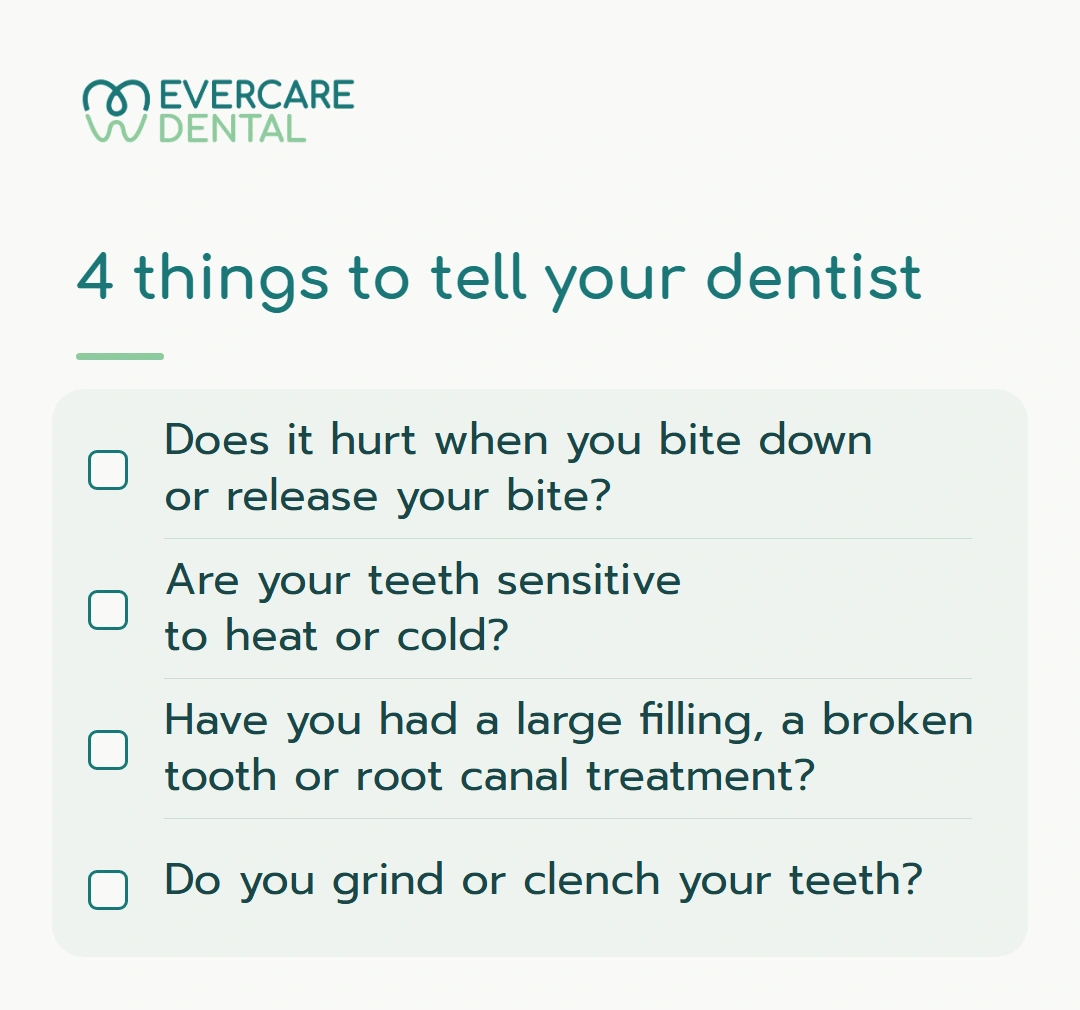
Jot these four things down and tell your dentist at the visit — they help with both the examination and the plan. Use the list to prepare for the visit, not to pick a restoration for yourself.
- Does it hurt when you bite down or release your bite?
- Are your teeth sensitive to heat or cold?
- Have you had a large filling, a broken tooth or root canal treatment?
- Do you grind or clench your teeth?
Pain on biting and sensitivity that comes and goes can be associated with a cracked tooth, so book a check soon even if it has already settled down. Your history of previous restorations and the way you bite together also help your dentist judge which piece suits the tooth.
If you have severe pain together with swelling of the face or jaw, a fever, or you think there is pus, see a dentist urgently. Go to an emergency department straight away if you have trouble breathing, speaking or swallowing, severe swelling inside your mouth, great difficulty opening your mouth, swelling or pain around the eye, or any change in your vision. Signs like these have to be checked for infection before anyone plans a restoration.
Common questions before you decide
An onlay keeps more of the tooth, so is it always better than a crown?
Not always. An onlay covers only the part that needs restoring and protecting, so it can be an option while the rest of the tooth is still in good shape. If the tooth is very weak, it may need covering all the way around with a crown. The aim is to keep the healthy tooth you still have and give that particular tooth the protection it needs.
Does the tooth have to be drilled, and will it take more than one visit?
The tooth does have to be prepared so that the piece fits, and how much is removed depends on the damage, the material and the design of the piece. Crowns made in a laboratory usually mean one appointment to prepare the tooth and another to fit the finished piece, with a temporary crown in between. Some systems make the piece at the clinic, though that does not suit every case. Ask your dentist how many visits your own plan needs and how to look after the tooth in between.
How do I look after the tooth afterwards?
Keep doing the basics: brush with fluoride toothpaste, clean between your teeth and come in for your regular check-ups. If you grind your teeth, ask us about protecting the restoration. A restoration can chip, break or come loose, so contact the clinic as soon as something feels wrong instead of waiting for the pain to build.
Want to know which option suits the tooth that is giving you trouble? Book a check with our dentists at Evercare Dental on Wireless Road. We examine the tooth, show you how much of it needs covering and talk the choice through with you. Message us on LINE @evercaredental to book.
References
- Cleveland Clinic — Restorative Dentistry
- NHS — Dental treatments
- NHSBSA — Inlays and Onlays (PDF)
- Leeds Teaching Hospitals NHS Trust — Crowns
- American Association of Endodontists — Cracked Teeth
- NHS — Dental abscess
- Cleveland Clinic — Dental Crowns

- Master of Science in Prosthodontics, Chulalongkorn University
- Doctor of Dental Surgery (Second-Class Honours), Chulalongkorn University
(This article is general information and does not replace an examination or advice for your own situation. Which restoration suits a tooth depends on your dentist's examination.)